
Sioux County Criminal Docket Searches
Most Sioux County criminal searches start online with the statewide Nebraska.gov JUSTICE one-time search. Accept the terms and search by party name. You can also type in a Sioux County case number if you have one. The terms deserve a close look. A one-time search costs $17. It returns no more than 30 results and stays open for three calendar days. It may still charge when nothing matches. Fresh filings in a Sioux County case can take 24 hours to appear.
For steady Sioux County work, the JUSTICE subscriber service searches by party name. It also searches by court type, case type or subtype, county, year, judge, and attorney. Pick Sioux County and the Sioux County court handling the matter. A calendar lookup helps spot a future hearing date. The case summary and register of actions, often called the ROA, hold the real criminal event history.
- Start with the exact case number if it is available; otherwise use the party name.
- Choose Sioux County Court or Sioux County District Court and confirm Sioux County before reading a result.
- Open the Sioux County case summary and read the dated ROA from filing through the most recent entry.
- Check the Sioux County charge, setting, order, plea, disposition, and financial entries as separate fields.
- Use the clerk or courthouse terminal for a specific missing public document or current confirmation.
Sioux County Criminal Court Types
Court type is the filter that matters most in Sioux County criminal docket work. Sioux County Court takes traffic cases, misdemeanors, municipal-ordinance violations, and preliminary felony hearings. A felony can start there. After bind-over, it can land in a Sioux County District Court CR case. That move creates a separate docket history. The new Sioux County District Court record often carries a new case number. It also shows a later run of settings.
| Sioux County court | Sioux County criminal docket role | Sioux County search check |
|---|---|---|
| Sioux County Court | Sioux County traffic, misdemeanors, ordinance matters, and felony preliminary proceedings | Look for the Sioux County early proceeding, hearing, waiver, dismissal, or bind-over |
| Sioux County District Court | Sioux County felony trial-level case after bind-over | Look for the Sioux County CR case, motions, trial activity, judgment, and appeal entries |
Harrison ordinance cases do not create a separate Sioux County municipal or justice-court search. No such court exists in the official structure. Those cases route to Sioux County Court instead. Anyone whose Sioux County search stops at one court level can miss the later stretch of a felony path.
Criminal Dockets: What They Show
A Sioux County criminal docket usually opens with the case header. Party information comes next. Then comes the charge block, dated ROA entries, settings, financial information, and any disposition. Nebraska calls this chronological court record a register of actions. Copy the Sioux County case identifier exactly as shown. Letters and zeroes included. The common criminal format pairs a CR prefix with a two-digit filing year and an assigned number. The portal display is what controls.
| Case number | Identifier such as CR-26-00001 in the state convention; preserve the portal's actual format. |
|---|---|
| Header and parties | Court, county, filing date, case type, judge, caption, roles, and attorneys when exposed. |
| Charge block | Public offense information, statute or code section, classification, and count where displayed. |
| ROA and settings | Dated filings, notices, hearings, motions, orders, plea, trial, and setting information. |
| Result and financials | Disposition and date, plus public assessed or paid costs, fines, restitution, or judgment information. |
Image links on a Sioux County case can open nonconfidential documents. Those copies are not certified. When an image is missing, the filing may be older, restricted, undigitized, or beyond the online image coverage.
Sioux County CR Docket Terms
Treat JUSTICE status words as descriptions of a Sioux County record, never as a stand-in for the order itself. No Sioux County-specific abbreviation sheet exists for shorthand like ORD, MOT, CONT, or DISP. Read the full written entry instead. Check any available image too. Only then assign meaning to a short code.
- Arraignment
- An appearance in Sioux County at which a criminal charge, rights, plea, or next setting may be recorded.
- Preliminary hearing
- The Sioux County Court probable-cause stage for a felony before a possible bind-over.
- Disposition
- The result or status resolving a Sioux County case or charge; it is distinct from a scheduled proceeding.
- Bond forfeiture
- A court action in Sioux County involving bond conditions or an appearance requirement.
Words like active, pending, disposed, appealed, reopened, and sealed are system descriptors. The dated ROA and the actual order supply the context that explains why a status appears.
Criminal Case Stages on the Docket
A Sioux County criminal ROA can stretch across the whole life of a case. The filing might be a complaint, citation, information, or indictment. An initial appearance or arraignment can come next. Then comes bond activity and a preliminary hearing for a felony. Pretrial entries and motions follow. A plea or trial, sentencing, and post-judgment activity can come after. Every entry marks a step in a Sioux County case. It does not always mark a conclusion.
Docket flow: Filing → Arraignment → Pretrial → Plea or Trial → Disposition → Sentencing
A preliminary hearing in Sioux County Court can end with a bind-over. The case can then shift into a later Sioux County District Court filing. The docket does not stop at the first result. Appeals, mandates, modifications, restitution or cost activity, and bond forfeitures may follow. Want to know where a Sioux County case truly stands? Read the latest dated ROA entry.
Sioux County Charge and Result
The charge block in a Sioux County case reports the alleged offense. It also gives the statute or code section and the classification when that information is public. It is not a finding of guilt. A scheduled arraignment or plea setting proves nothing more either. The date may pass without the appearance happening, or without any sentence being imposed. The real Sioux County result appears later. Look for a disposition, judgment, sentencing, dismissal, acquittal, deferred result, or other recorded outcome.
Read the later record. A motion entry means a party requested a ruling; look for the later order. A future setting means a hearing is scheduled; look for the later ROA entry to learn what happened.
Terms like guilty plea, conviction, dismissed, deferred disposition, probation, and sentence only mean what their place in the sequence gives them. A blank field, likewise, does not prove that no bond, hearing, or action ever occurred.
Sioux County Criminal Docket Courts
Sioux County runs its courts through two separate clerks. Michelle Zimmerman, Clerk of the District Court, holds the Sioux District Court criminal files. Joni Roberts serves as Sioux County Court clerk magistrate. County court office work is routed through Dawes County Court. Hearings and jury trials all stay in Sioux County. Match the clerk to the court listed on your case.
The District Clerk's official page and the Sioux County Court page lay out the two routes. Pick the right one before you send anything. A District Court felony request, for instance, should never go in as a County Court traffic matter.
Sioux County Criminal Terminal Access
The paid online docket search can come up empty. The courthouse JUSTICE public terminal is the free fallback that state policy identifies. You can search there by party name or case number. It helps with a suspected 24-hour lag. It also covers a search run at the wrong court level, an older case, or a result set that needs a more exact identifier.
The official District Court records materials break a criminal record into separate parts. Those parts are the case summary, ROA, docket, financial records, index, judgment, and the case file itself.
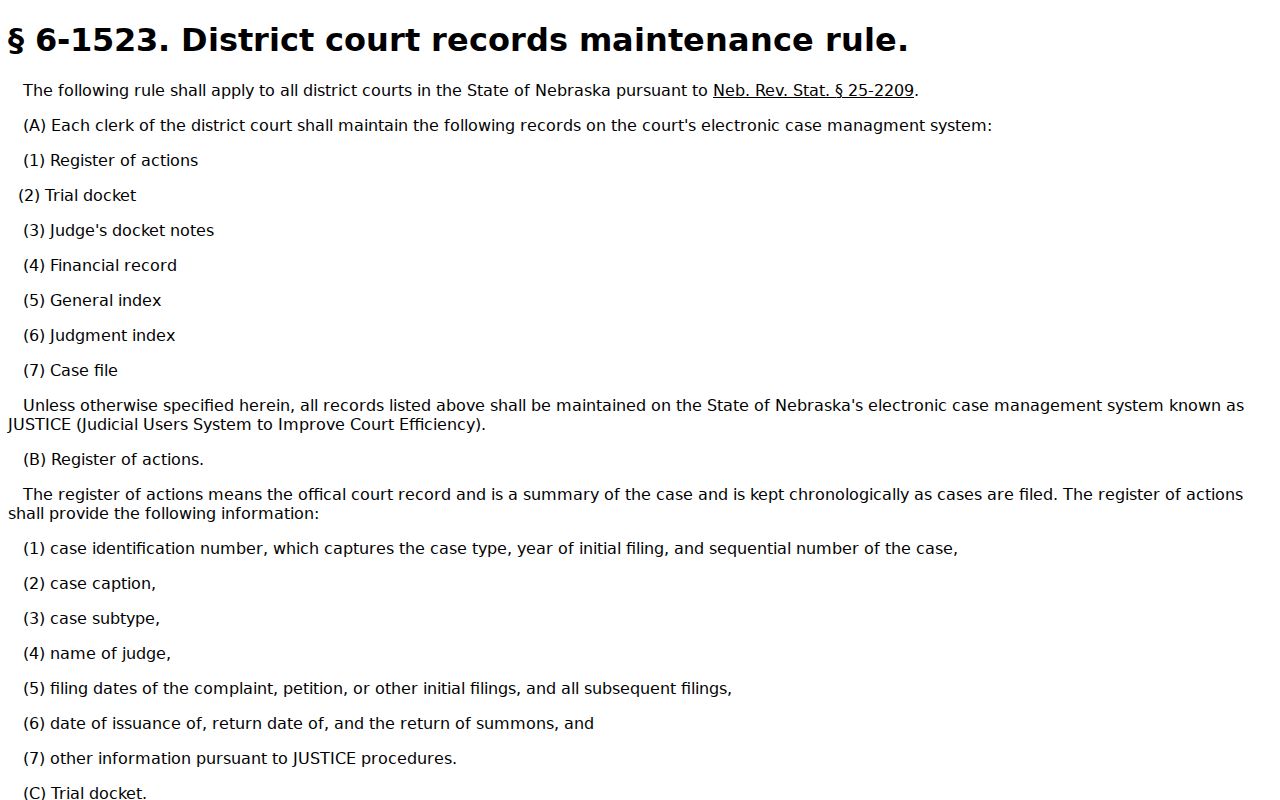
That structure matters. A search result, a dated register entry, an image, and a clerk-certified copy each serve a different purpose, so ask for the specific filing, order, or judgment you need rather than a vague complete file.
For Sioux County criminal docket access, use the free terminal to confirm the court level and exact case number first. Confirm the court level and exact case number. The terminal cannot open restricted material. But it can save you from paying for another name search when the court selection or case identifier was the real problem. Sioux County clerk staff can then route a precise document request to whichever court keeps the file.
Note: A formal written request should identify the complete party name, case year and type, and preferably the case number.
Access Rules for Criminal Dockets
Nebraska opens court-record information to the public unless a statute or court rule says otherwise. That principle has limits online. JUSTICE may display a case summary or a thin result while holding back a confidential image, and juvenile, sealed, or otherwise restricted material must go through the proper clerk route.
Public-access rules.
Nebraska Supreme Court Rule §1-803 gives the public the same court-record information unless another rule or statute limits it.
Article 8 electronic-access rules recognize remote access, courthouse terminals, and restrictions on records and images.
Neb. Rev. Stat. §43-2,108 provides special confidentiality rules for juvenile court records.
A restricted display does not mean a case was dismissed or never filed. A public document may have no image online. Ask the correct clerk for the nonexempt record or a certified copy.
When a Sioux County criminal record will not come back online, a written Nebraska Public Records Act request is the documented fallback. Give the complete party name. Add the case year and type, the case number if you have it, and the specific record you want. State policy requires formal requests under the Act to be handled immediately. They are forwarded through the State Court Administrator route. Which Sioux County clerk handles it still turns on the court level.
Sioux County Criminal Setting Resets
A calendar date is a discovery tool. It is not the final word on the current criminal setting. Search the Multi-Court Case Calendar by court type and Sioux County, then by current or future date or by at least two surname characters. It can locate future settings. But it is not the criminal ROA, and its own warning says no result does not necessarily mean no court date.
To audit a moved setting, trace the sequence. Start with an original notice of setting. Then move through any continuance, reset, or order, and end at the later notice. Treat the newest entry as the working date only once clerk confirmation agrees with it. The Sioux County pattern of first-Friday criminal and traffic arraignments is local context. It is not individual notice.
If the date stays unclear, search both Sioux County court levels after a felony preliminary stage, use the courthouse terminal, and contact the court holding the case. The separate county events calendar does not establish a criminal court setting.